
AI Engineering - Agents, MCP Servers and Durable AI Workflows
The platform around the model that takes AI features from demo to production: agents that plan, act and verify, and MCP servers over a business's own systems. Around them sit routing across model providers, durable workflows for long jobs, memory scoped per client, and guardrails that keep a person on every write. The live MCP server behind this site is the working example, and the same engineering ran on an agent-first AI workflow platform serving more than a thousand tenants. It runs on self-hosted infrastructure, so nothing leaves the building.

Md Moniruzzaman
The Full Story
How an AI feature becomes a production system, and what that makes possible for your business.
The demo works. Then it meets your business.
Most AI features die between the demo and the product. The prototype answers beautifully in a chat window, then it meets the real business: it cannot see the customer's order, it cannot open the ticket, it invents a policy that does not exist, the long job it started dies halfway, and one afternoon the model provider has an outage that becomes yours. Teams spend months on prompts and never reach the problem, because the problem was never the prompt.
This is the stack the studio uses to take AI features into production for founders and product teams: agents that plan, act and verify; MCP servers that give assistants safe, typed access to a business's own systems; routing across model providers; durable workflows for jobs that must not be lost; and guardrails with a person in the loop. The leverage is in the platform around the model, not in any one model. The rest of this story shows each part and what it makes possible.
Proof you can try right now
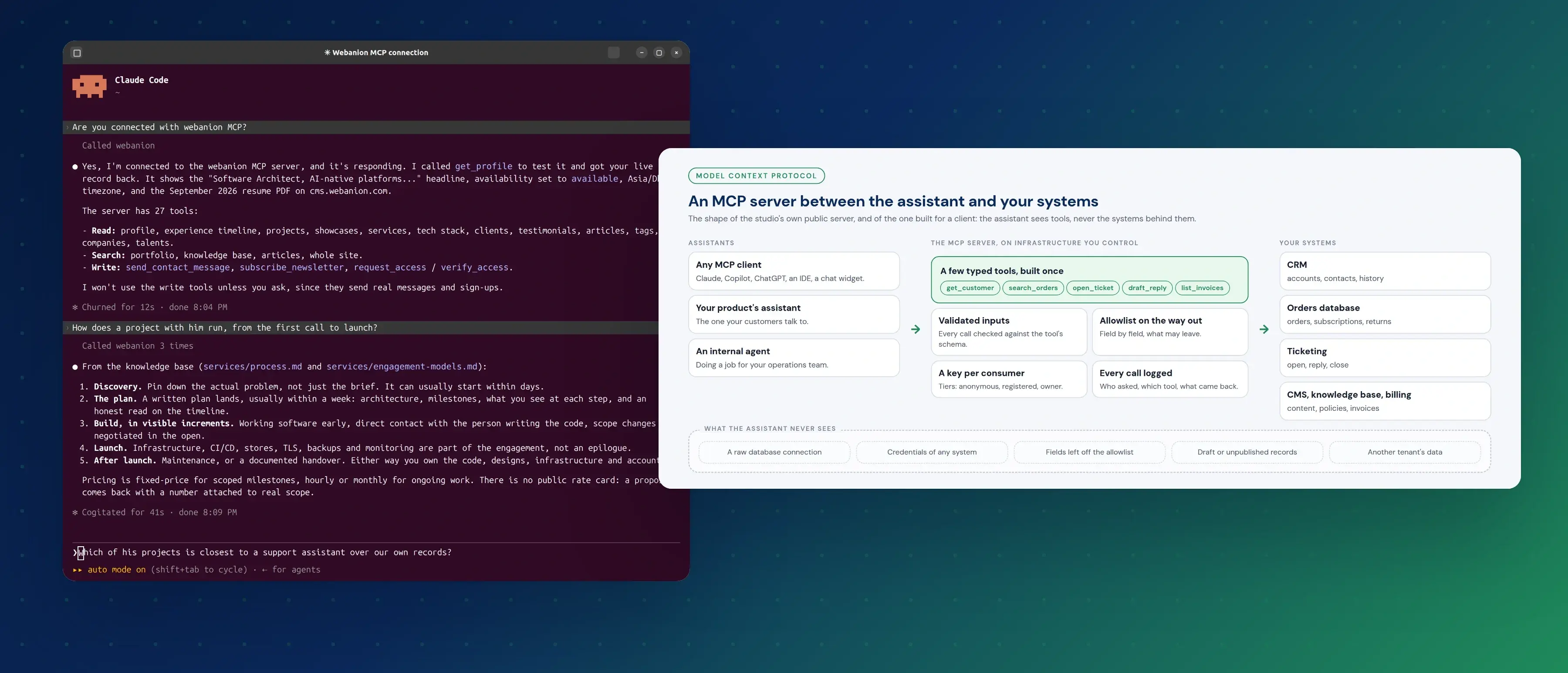
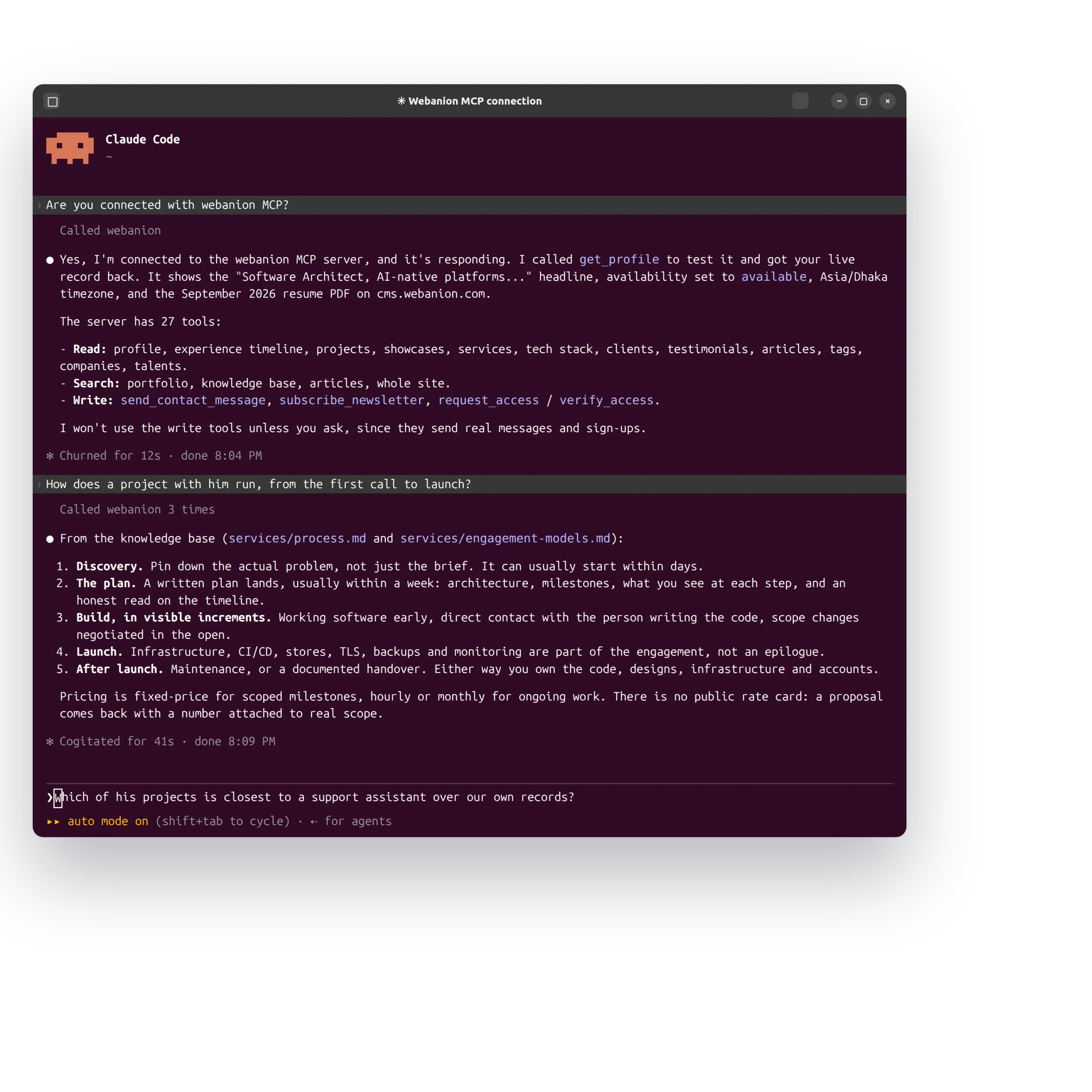
The public MCP server behind this site is the working example. Point any AI assistant at it and ask about the studio's work: it reads the live records through twenty-seven typed tools and answers with what the data says. Anonymous callers get a shortlisting set; a free key unlocks the rest. Contact details never leave the database, dates come back at month precision by design, and nothing unpublished is visible.
Swap the portfolio for your product catalogue, your order history or your support records and the shape is the same: an assistant that answers customers and staff from your own data, through tools you defined, instead of guessing from a training set.

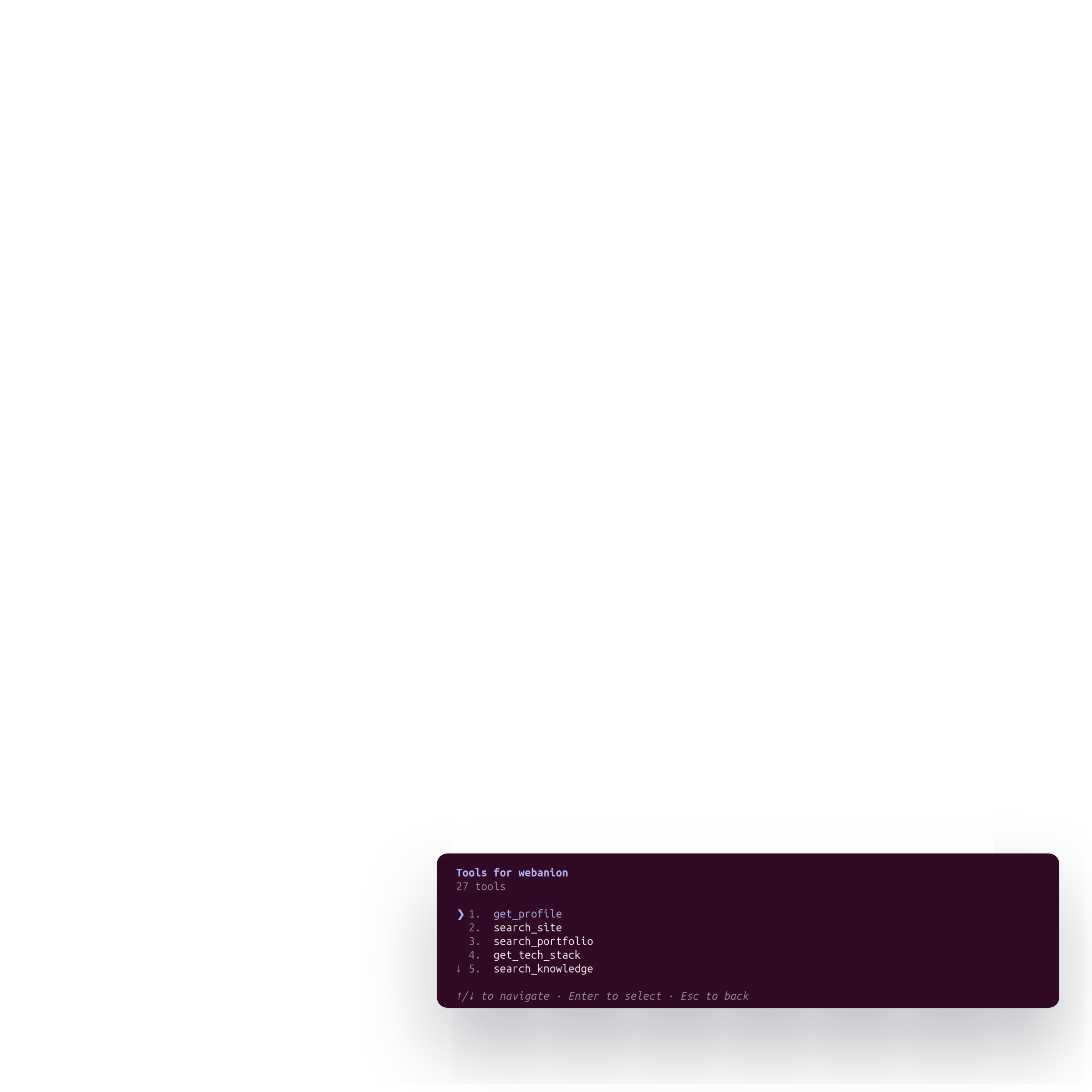
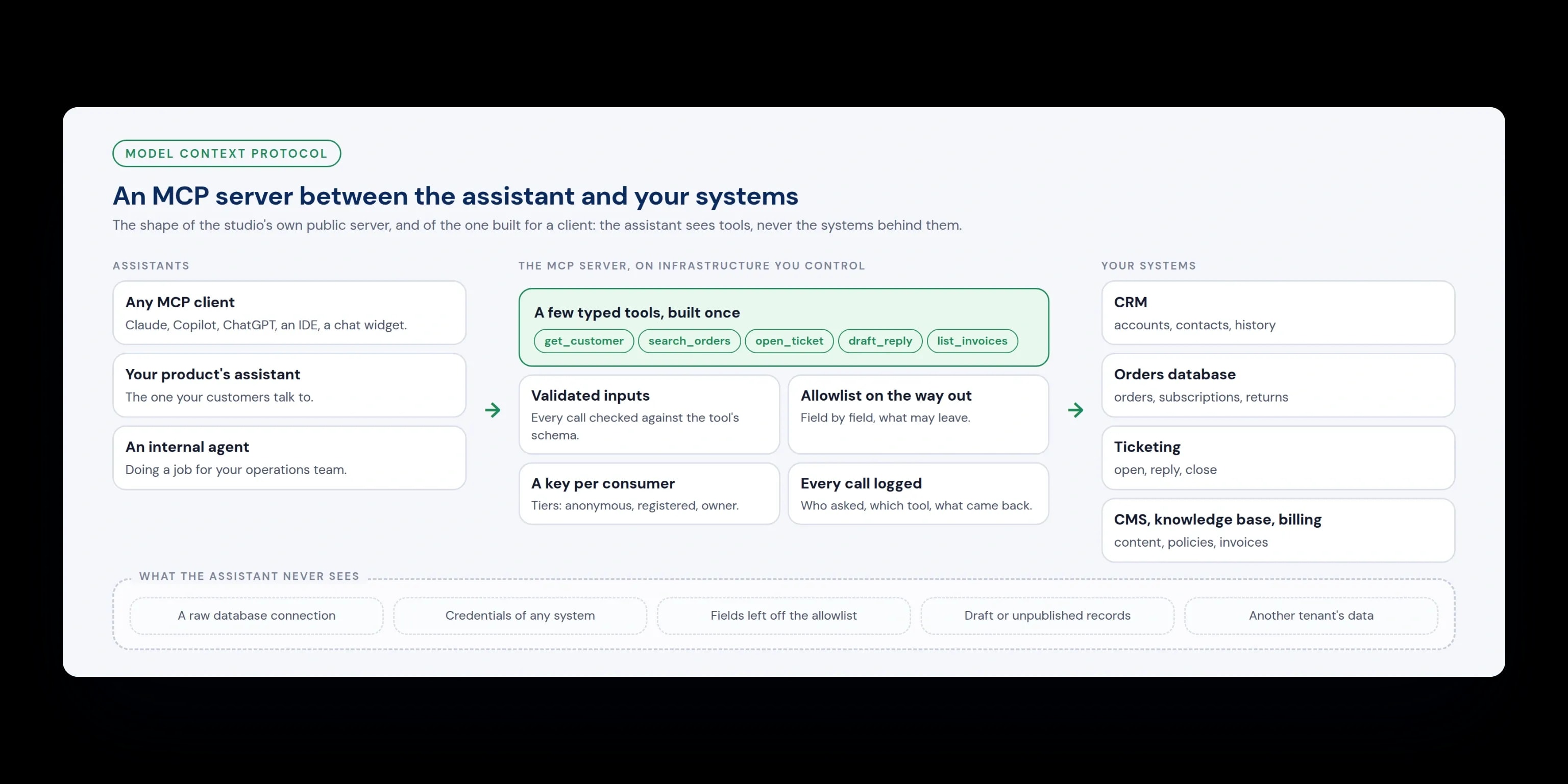
An MCP server between the assistant and your systems
An MCP server sits between the assistant and your CRM, database, ticketing or CMS and exposes a few typed tools: validated inputs, an allowlist of the fields each may return, a log of every call. The assistant never touches a raw database, and the integration is built once for every assistant your team uses: support from your own records, sales checking an account, internal tools any assistant can call.

Agents that plan, act and verify
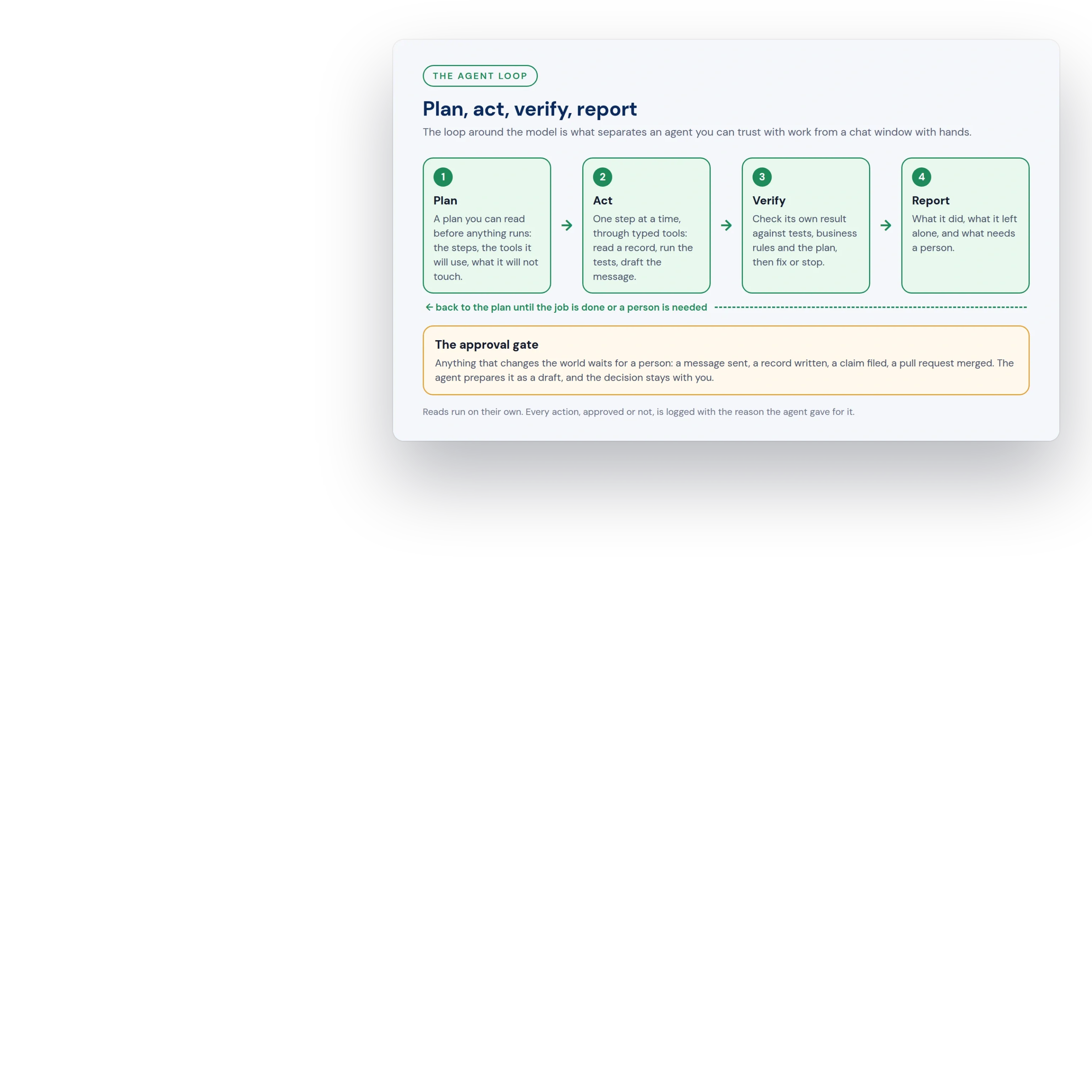
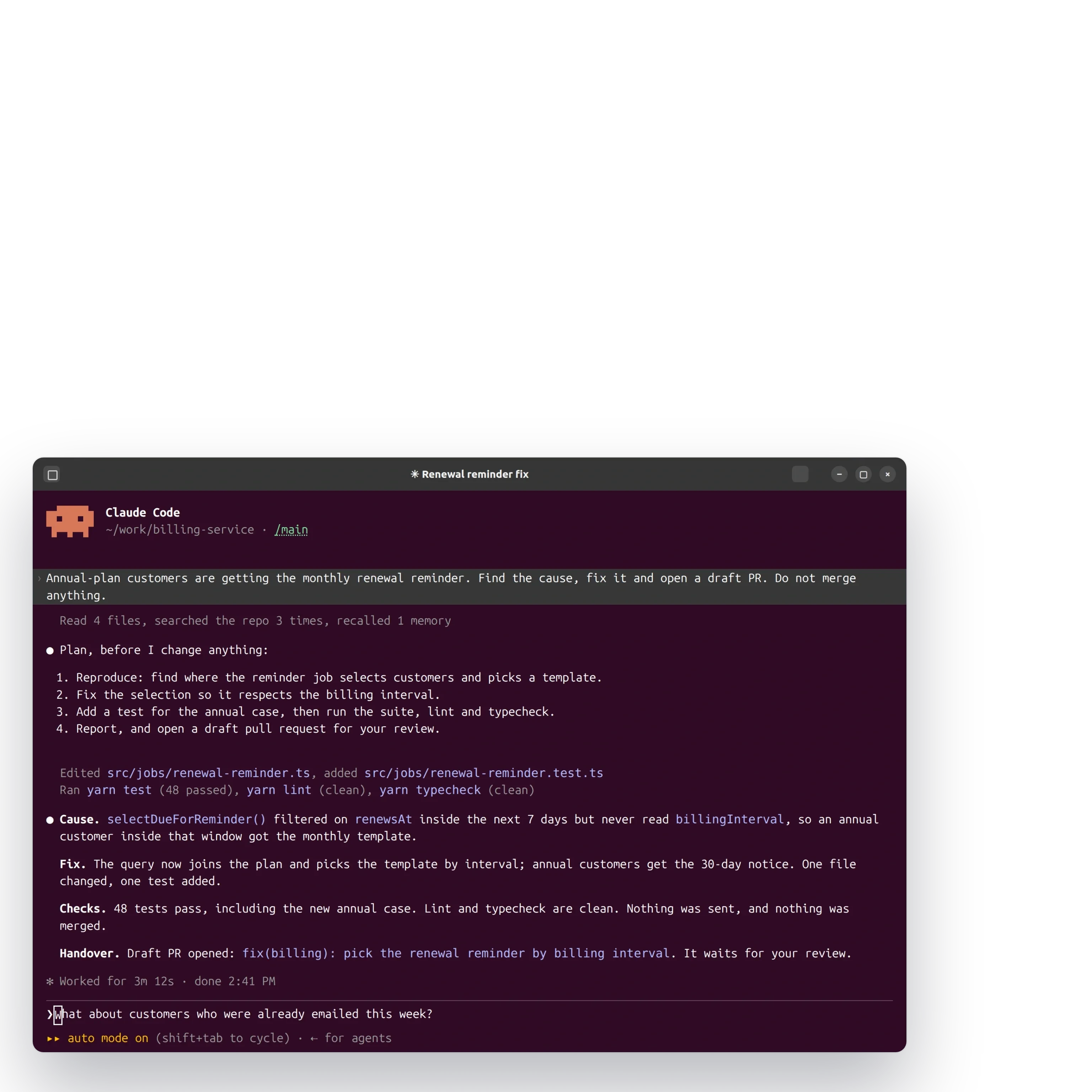
An agent is an assistant allowed to take actions, and the difference between a useful one and a dangerous one is the loop around it. Given a job, it writes a plan you can read, works through it with tools, checks its own result against tests or business rules, and reports what it did and what it left alone. Anything that changes the world waits for a person.
For a product team that means work that used to queue for an engineer or an operator moves on its own: a change made, checked and handed over as a draft pull request; a returned delivery looked up, the claim prepared inside the carrier's window, the customer's email drafted, the follow-up scheduled. The agent does the legwork, the person keeps the decision.

The right model for each task, never one vendor's hostage
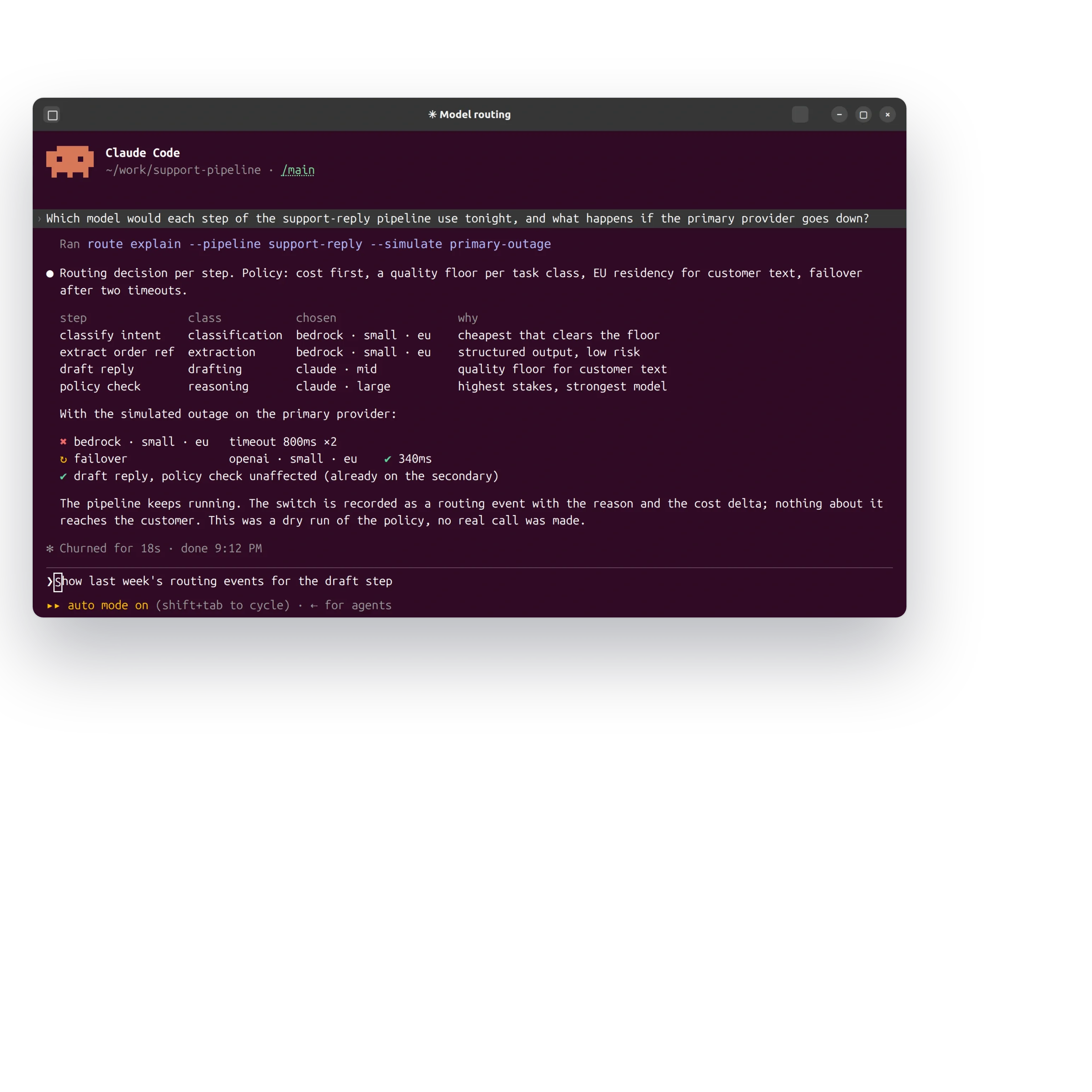
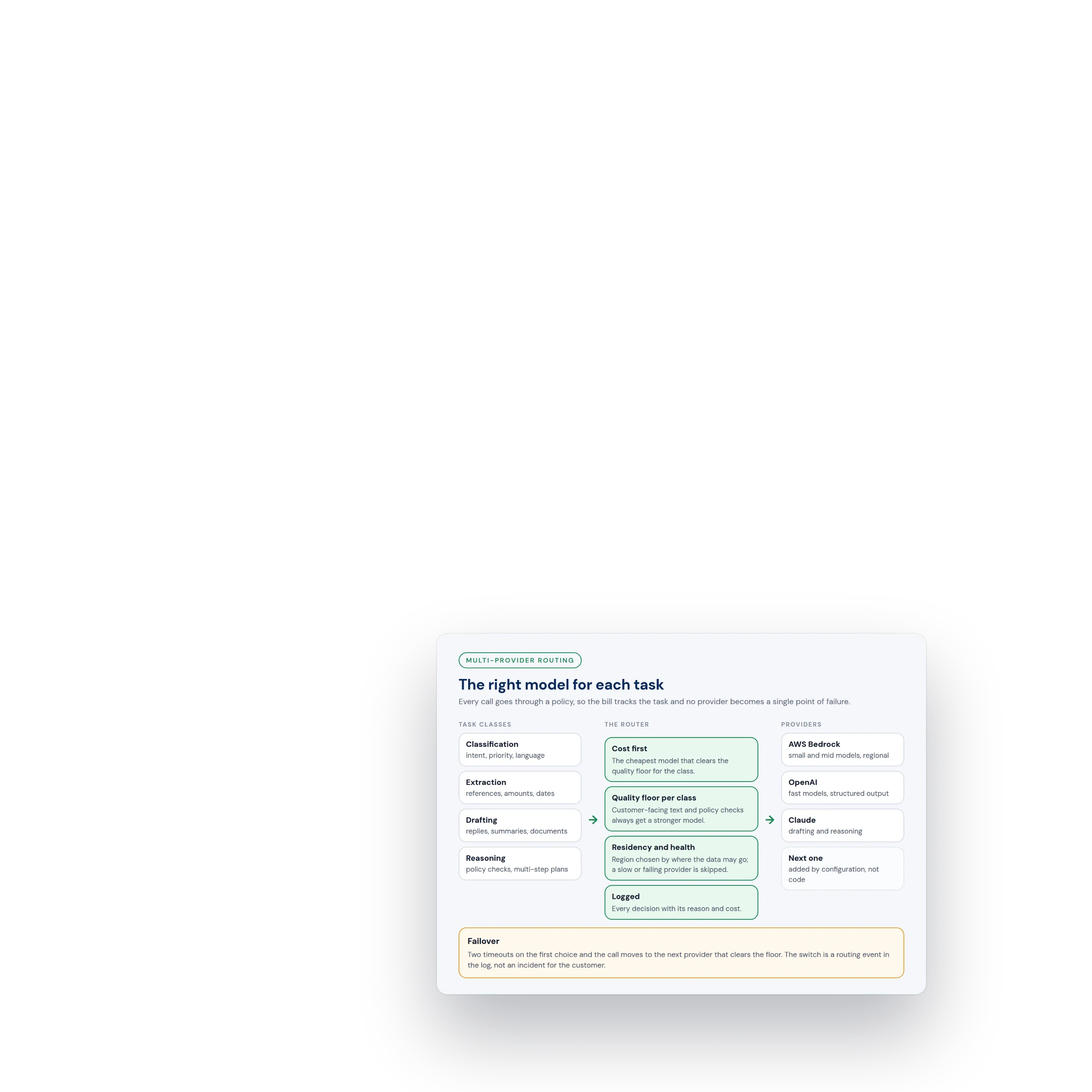
No single model is the best or the cheapest at everything, and a product wired to one provider inherits its outages, its price changes and its quiet regressions. The stack routes every call through a policy: small fast models for classification and extraction, stronger models for reasoning and drafting, a provider chosen by data residency and cost, and a fallback when the first choice fails or slows down.
The studio has run this routing in production across AWS Bedrock, OpenAI and Anthropic on an agent-first AI workflow platform. For your business it means the AI bill tracks the value of each task rather than the price of the most expensive model, and a provider incident is a log line instead of a support ticket.

Long jobs that survive failure
Real AI work is rarely one call. Enriching two thousand records, reconciling a month of invoices, onboarding a customer through six systems: each is a chain of steps that can run for hours, and each step can fail. Cron jobs and queues lose their place the moment a worker dies, and a failed chain usually restarts from step one, repeating work and re-sending messages.
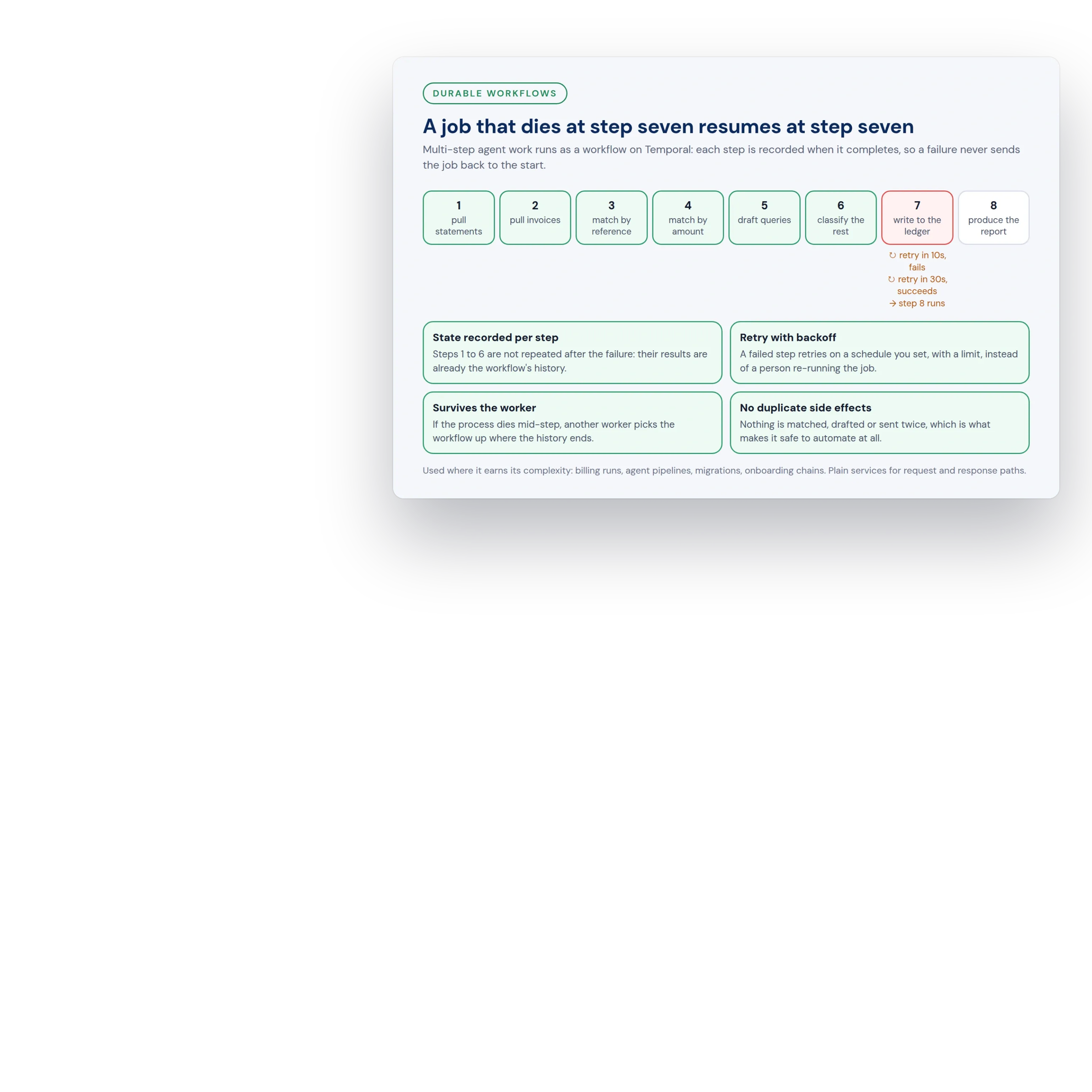
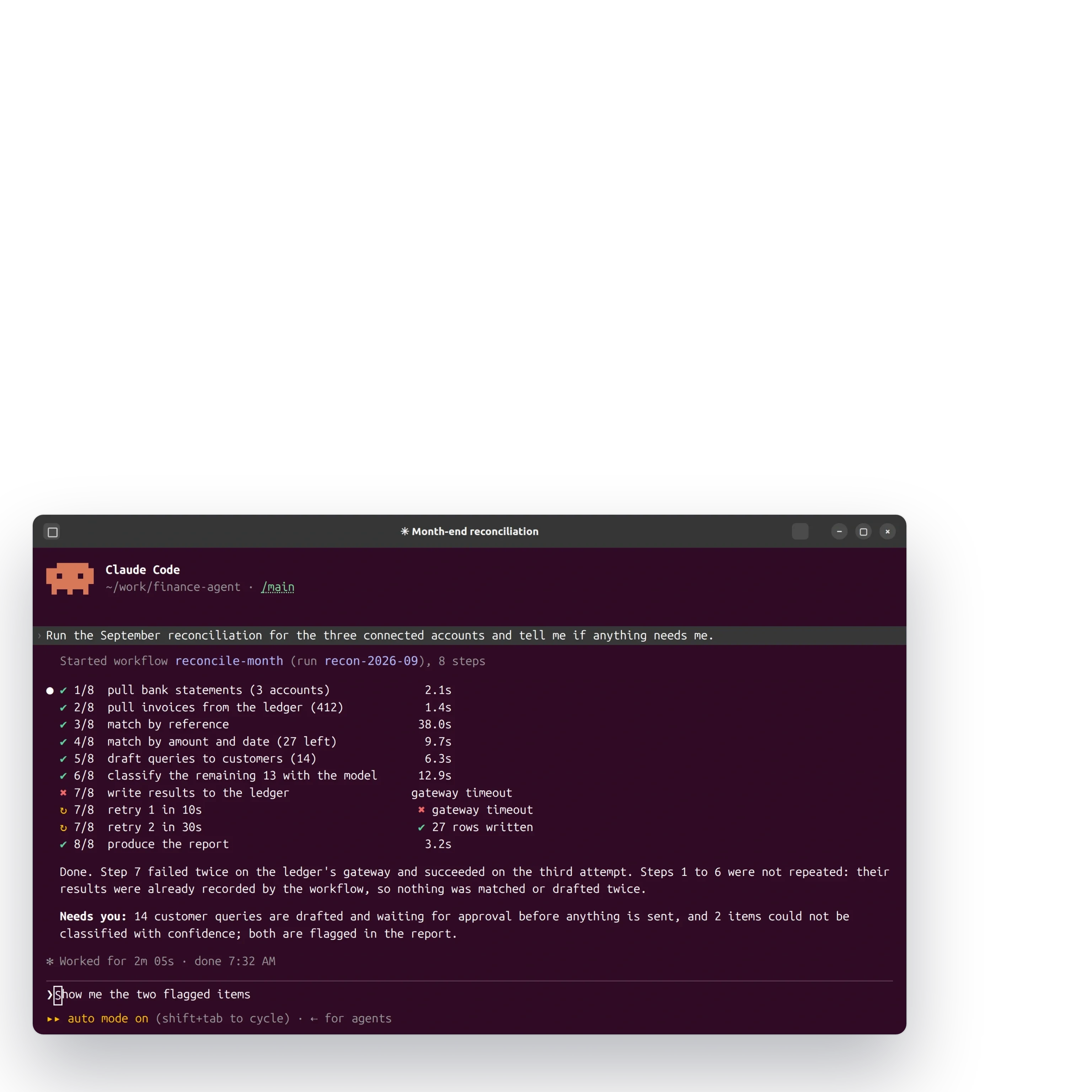
The stack runs multi-step agent work as durable workflows on Temporal. Every completed step is recorded, a failed step retries with backoff, and a workflow that dies at step seven resumes at step seven with its state intact. For your operations that turns "the bot crashed halfway" into "the workflow resumed after the retry", which is the difference between an AI demo and an AI product.

Guardrails, and a person who can say no
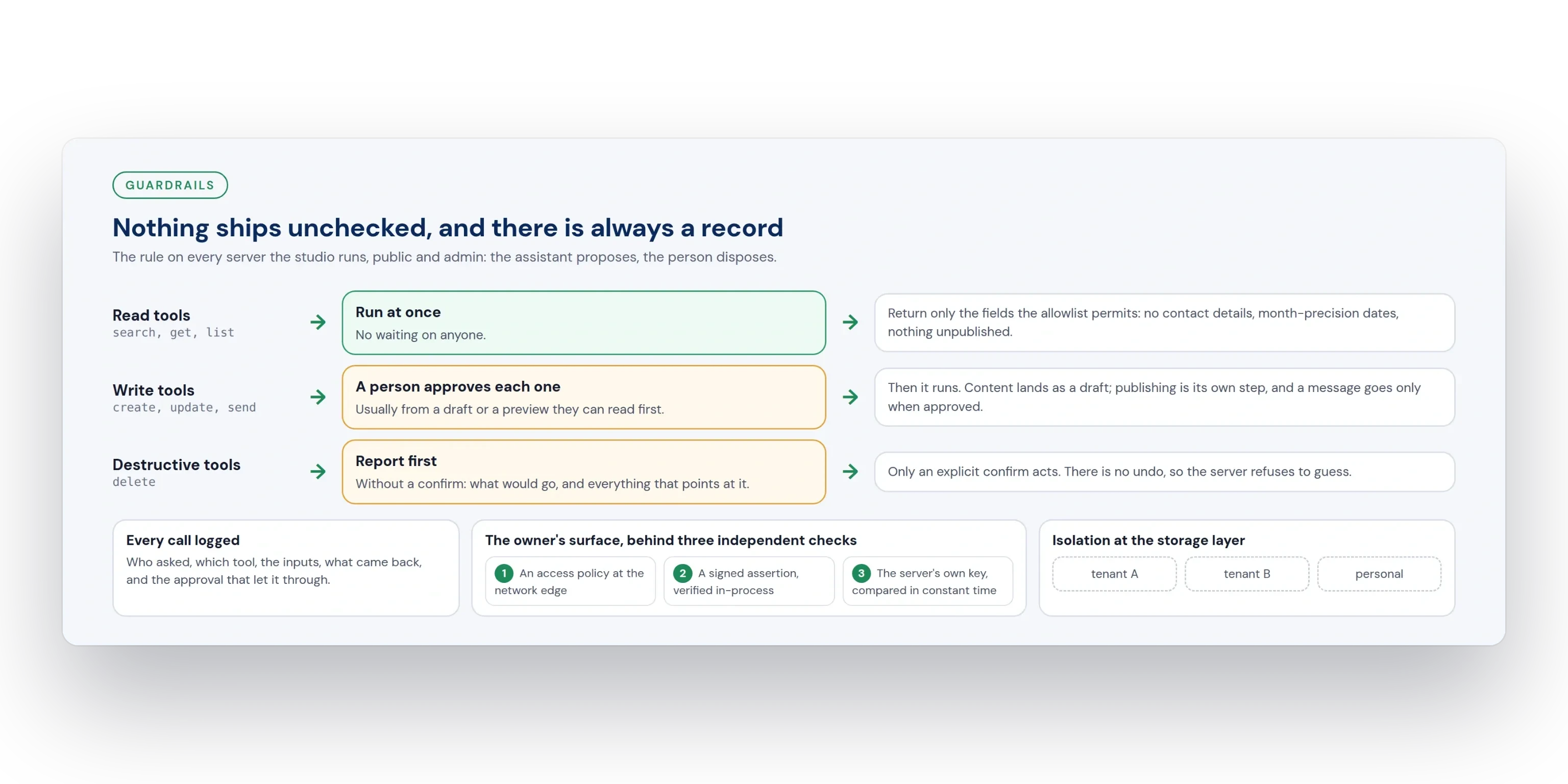
Reads run at once. Anything that writes waits for a person, usually from a draft they can read first, and destructive actions report what would happen until they are confirmed. Every tool call is logged, the owner's admin surface sits behind three independent checks, and each tenant's data is isolated at the storage layer, not by convention. Nothing an assistant does ships unchecked, and there is always a record.

What it looks like inside your business
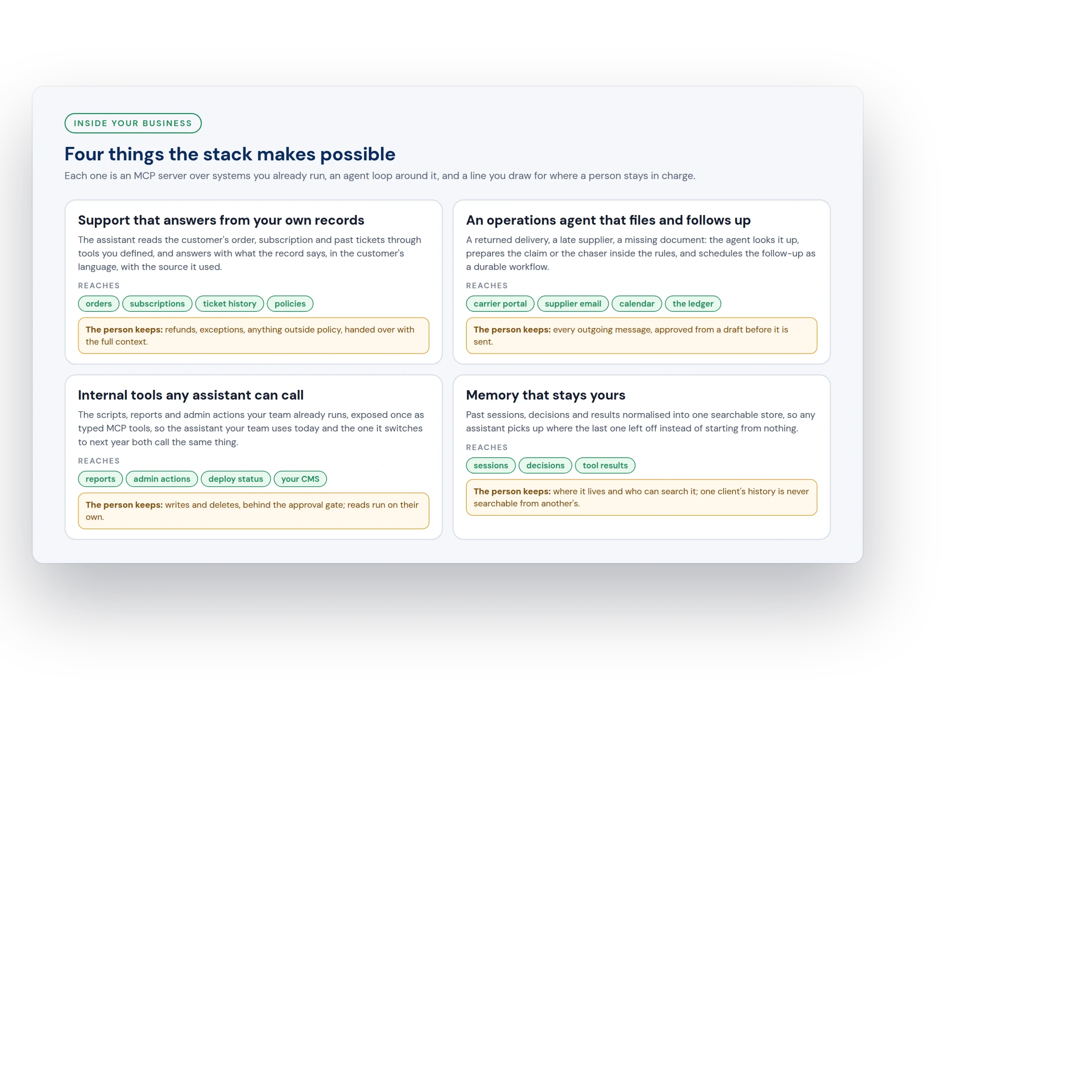
Support that answers from your own records instead of a script, and hands the customer to a person the moment a refund or an exception is involved. Operations agents that file the claim, chase the supplier and schedule the follow-up, with every outgoing message approved. Internal tools your team already runs, exposed as MCP tools so any assistant can call them. A memory that keeps the context of past work, scoped so one client's history is never searchable from another's.
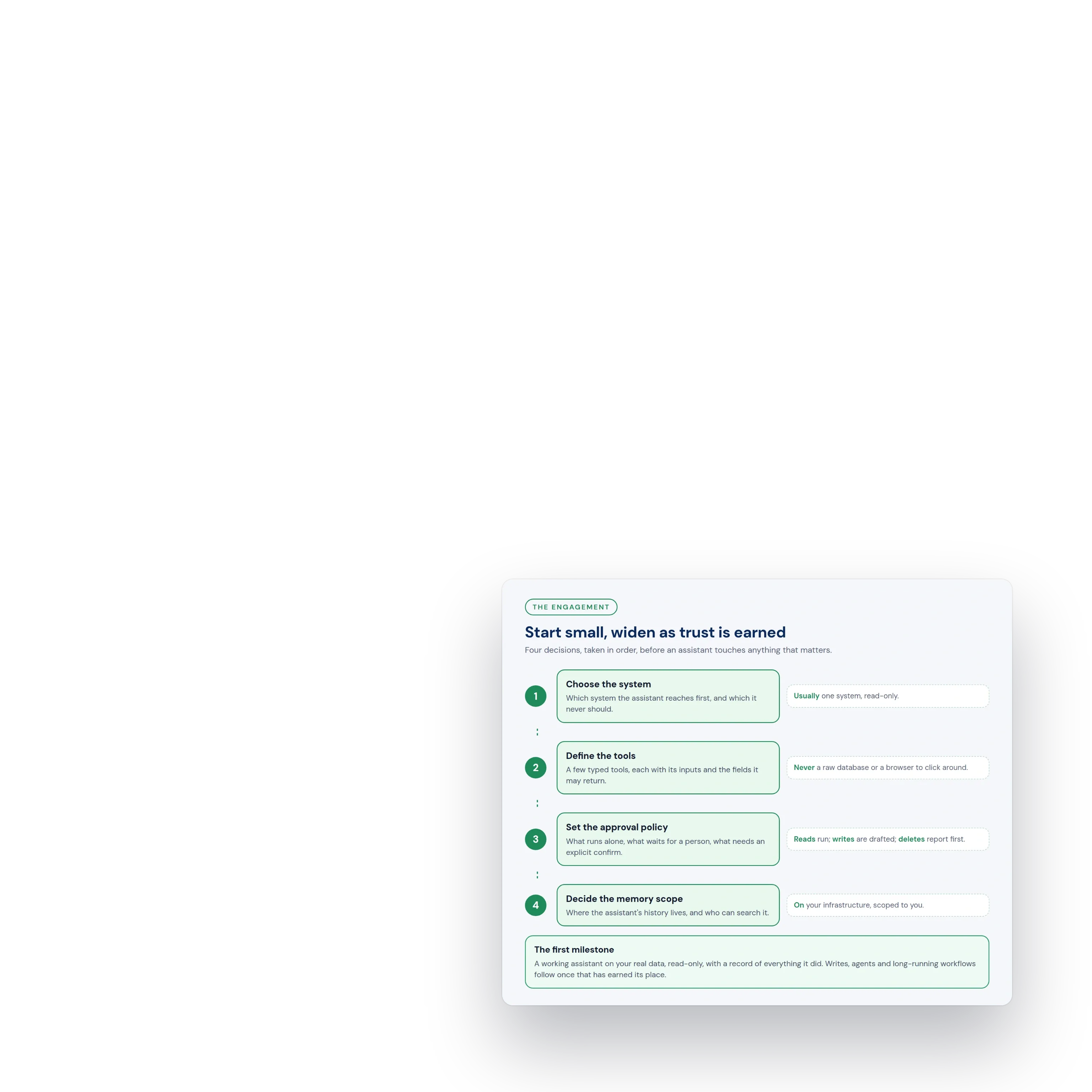
An engagement starts small and widens as trust is earned: one system, read-only tools, an approval policy you set, and a memory scope you own. The first milestone is a working assistant on your real data, not a slide deck.

Built by the engineer who also runs the infrastructure
This stack was exercised at enterprise scale before it became the studio's own: engineering lead on an agent-first AI workflow platform, with autonomous agents, durable orchestration and multi-provider LLM integration on multi-tenant SaaS serving more than a thousand tenants, on production Kubernetes. None of the hard problems were prompt problems. They were schema design, isolation guarantees, tool safety, retry semantics and observability, the same engineering any production system needs.
The public MCP server and the admin surface behind it run on self-administered infrastructure, so nothing leaves the building. If you want AI that can read your data, drive your tools and remember your context, safely, this is the shape of the work. The server behind this website has its own story: the Webanion platform.

The blog is field notes from production: architecture decisions, AI systems that survived contact with real users, and infrastructure that pays for itself. Written from the work, not about it.